


Kite Waveboards
Kite waveboards, once classic surfboards were used, but they quickly succumbed to the stronger stresses of kiting.
Therefore, we are talking about special kite waveboards that have been built with modified shapes and special reinforcements for this purpose.
However, the shapes have also changed repeatedly in recent years, so that there are now classic, i.e. "pointed" waveboards, and short, more stubby-shaped boards.
These are often a bit easier to ride, turn more easily and often provide a lot of fun - even in not-so-perfect conditions!
Features - Kite Waveboard
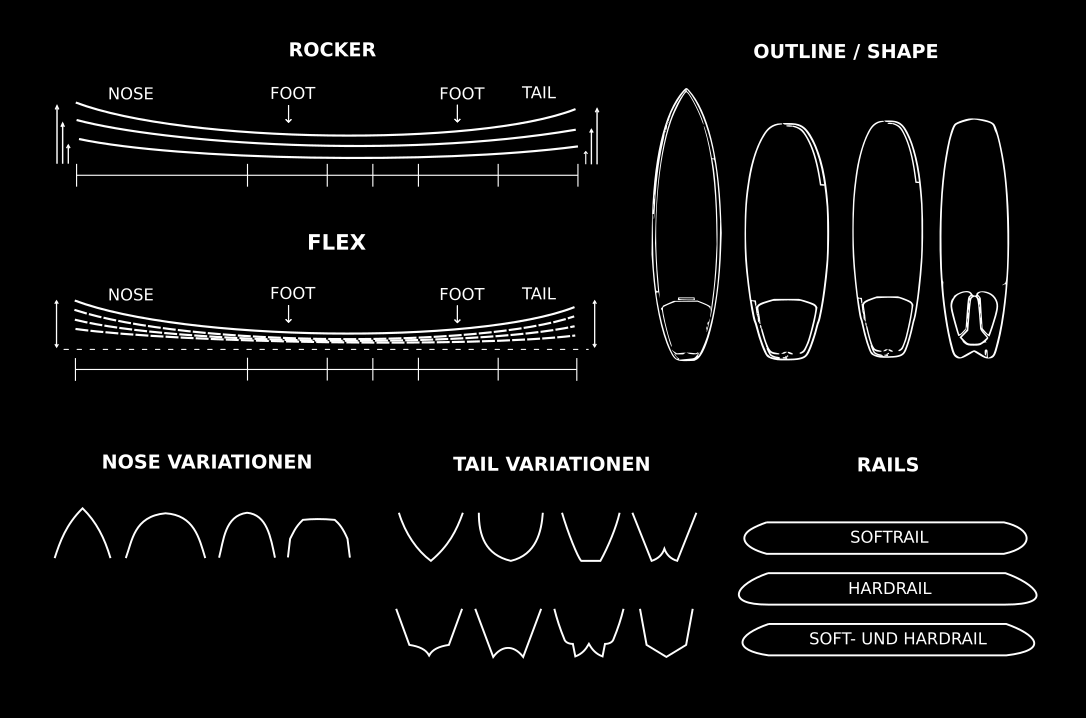
Rocker
The rocker describes the curvature of a board. In principle, the larger the rocker, the more maneuverable the board is in turns and the higher speeds can be achieved.
The curvature also minimizes the risk of the nose digging into the wave in choppy water. However, with increasing rocker, the effective planing/running surface of the board is reduced. This makes going upwind more difficult.
Flex
Flex defines the stiffness or hardness of the board. The higher the flex, the softer and more comfortable a board rides in choppy water or in waves.
The "springing" of the kiteboard is gentle on the knees. However, too much flex can quickly lead to a spongy riding feeling. Furthermore, waveboards with higher flex are more susceptible to dents/damage due to material and construction. A transport bag or a board sock can help.
Outline / Shape
The outline or shape of a waveboard describes its silhouette in plan view. Is it rather straight (parallel), curved, or a combination of both? Boards with an angular,
from nose to tail, parallel outline offer higher speeds. Often in combination with a thicker material, the flex is reduced and riding comfort decreases. Turns have to be ridden in larger radii.
This shape is often found on light wind waveboards. A board with a curved outline guarantees you more maneuverability for tighter turns. Especially if you ride a board with less rocker.
The mixed forms of both outlines form a hybrid. These are usually only curved in the nose and tail areas and straight in the center.
This gives you the advantage that you can reach high speeds while standing in the center of your board. If you shift your weight and stance towards the tail, it ensures tight turns.
Nose
The nose is the tip of the waveboard. It determines how well the board planes and how cleanly you can ride a wave. We distinguish between a pointed, wide, and short nose.
The narrow, pointed nose guarantees aggressive and sporty performance in the wave. It offers more maneuverability. This allows for faster and tighter turns.
However, the lateral stability and buoyancy are lower compared to the wide nose, which in turn requires riding skill. In contrast, the wide nose offers more buoyancy and tipping stability.
Especially for getting started in wave kiting and on light wind days, such boards show their strengths. However, these are only suitable for smaller waves and turns have correspondingly larger radii.
The short nose is often found on freestyle waveboards. They have the advantage that they save weight for acrobatic jumps and offer less wind attack surface.
Tail
The tail describes the rear of the waveboard. There are countless variations and categories. In principle, the wider the tail, the more buoyancy your board has, the higher the lateral stability, and the better its planing behavior.
A straight tail guarantees better guidance, while a narrow, tapered tail makes your board faster. The maneuverability with narrow, r
ounded tails for radical turns is higher than with wide tails, which have to be ridden in larger radii.
The former ensures a loose riding feeling and easier carving for experienced riders, while the latter shows its strengths in light wind and for beginners.
Rails
The rail describes the distribution of material removed at the board edges. Viewed in cross-section, common rail shapes result in ratios of 50/50, 60/40, and 80/20.
The soft rail with a material distribution of 50/50 is particularly suitable for smaller waves and light wind. It offers more buoyancy when riding, but the round rail shape makes edging more difficult.
Radical and fast turns are therefore not possible.
