
-
-
GA
Very low stock (2 units)Regular price €799,00 EURUnit priceUnavailable-
Airush Kiteboarding
Airush Apex Eco Kiteboard 136x40 (used)
Very low stock (1 unit)Regular price €400,00 EURUnit priceUnavailable-
- Up to 15% off
Core
Very low stock (1 unit)Sale priceFrom €665,00 EUR Regular price €779,00Unit priceUnavailable -
Airush Kiteboarding
Very low stock (2 units)Regular price €619,00 EURUnit priceUnavailable-
- Sold outUp to 13% off
-
- Sold out
-


Twintips
Twintips, also known as bidirectionals, are the dominant kiteboards on the beach. But no two kitesurfers are alike, and no two kiteboards are alike!
Thus, there is an ideal board for different disciplines and conditions. Most manufacturers classify their models into the categories of Allround / Freeride, Light Wind, Freestyle, Wakestyle, and Big Air.
However, the rider's skill level - Beginner / Advanced, personal ambitions, body weight, and height also factor into choosing the right board.
We have created a helpful overview below and are happy to advise you.
And which type of kiter are you? Determine your style!
Allround / Freeride: Allround or Freeride kiteboards are usually characterized by comfortable riding characteristics, coupled with a high to moderate flex and a flat rocker line.
The adjustments in characteristics are moderately chosen. They show good upwind performance and good planing behavior. The flex protects the knees in choppy water and hard landings.
The outline gives the boards good turning behavior and stable guidance with the necessary edge hold. Freeride kiteboards are simply characterized by good all-round properties.
They cater to the majority of kitesurfers but are not necessarily ridden by beginners.
Beginner / Light Wind: Beginner kiteboards are often found among freeride kiteboards, but not every freeride kiteboard is suitable for beginners. Beginners usually use very large boards without rocker, with some flex or stiffer, and a straight outline.
This guarantees sufficient buoyancy and fast planing even with incorrect kite control. In addition, going upwind becomes child's play,
as the use of maximum edge surface ensures the necessary UP Wind Performance. Due to these characteristics, such boards are used in light winds and most kite schools.
Freestyle (Advanced): Freestyle kiteboards guarantee you maximum performance on the water.
They are characterized by their medium rocker line, excellent turning ability, and strong pop, especially for unhooked jumps.
Their harder tuning offers significantly less riding comfort than a freeride board. You will realize this at the latest in choppy water and your first landings.
Channels on the bottom provide perfect guidance and maximum edge hold. Due to their lower planing capabilities and upwind characteristics, they require more pull from the kite or stronger wind.
As a result, freestyle boards are often ridden by kiters with boots to maximize edge holding and pushing.
Wakestyle (Advanced): Wakestyle kiteboards are very special. Their very pronounced rocker line guarantees excellent turning ability and minimizes nose-diving with the tips in choppy water, but noticeably reduces planing and upwind performance.
Wakestyle boards are usually designed for kite boots and excel with a stiff, robust construction.
A grind base on the bottom protects the board when riding over obstacles, similar to wakeboarding. Their unhooked performance with excellent pop is undisputed.
Wakestyle boards are usually equipped with short fins. The loss of grip is compensated by a complex channel system and larger boards.
Guide Table - Board Size
| Body weight | 50 - 65kg | 60 - 75kg | 70 - 85kg | 80 - 95kg | > 95kg |
| Length cm | 132 - 135 | 134 - 138 | 137 - 145 | 142 - 150 | 145 - 155 |
| Width cm | 39 - 41 | 40 - 42 | 41 - 46 | 45 - 48 | 46 - 50 |
Characteristics - Kiteboard Twintip
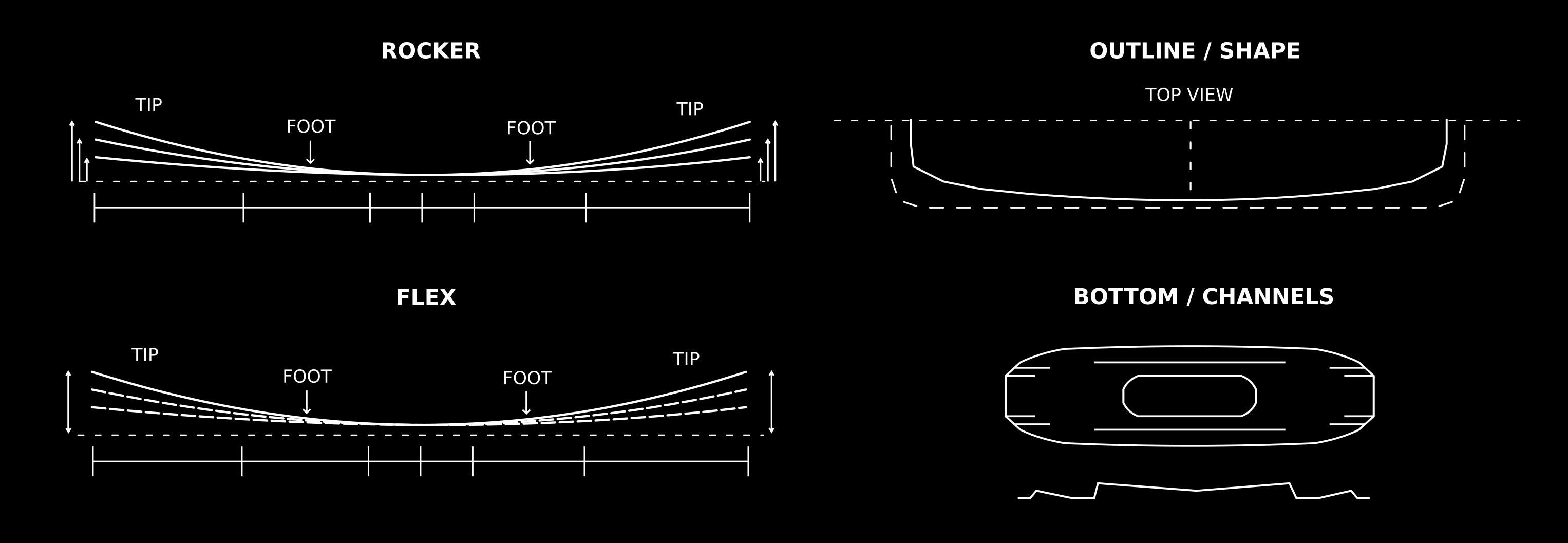
Rocker
The rocker describes the curvature of a board. In principle, the greater the rocker, the more agile the board behaves and the better the pop when taking off.
The curvature also minimizes the risk of nose-diving into waves with the tips in choppy water. However, with increasing rocker, the effective planing/running surface of the kiteboard is reduced.
This makes going upwind more difficult and must be compensated with more kite power (larger kite/aggressive shape). Usually, kiteboards with a lot of rocker are reserved for experienced freestylers or wakestylers.
Flex
Flex defines the stiffness or hardness of a board. The higher the flex, the softer and more comfortable a board rides in choppy water.
The "springing" of the kiteboard is easy on the knees and particularly popular with freeriders. However, too much flex can quickly lead to a vague or wobbly riding sensation. In addition, the pop when jumping is significantly reduced.
Outline / Shape
The outline or shape of a kiteboard describes its contour. Is it rather angular, even edgy, or tapered towards the tips?
The more angular a board is, the easier it is to go upwind and maintain edge hold. Boards with an angular outline have excellent planing and upwind characteristics, but lose out in terms of turning agility.
In addition, kiteboards with edgy tips tend to spray more water when riding and have an increased risk of nose-diving in choppy water. In light winds, such boards play to their strengths.
Bottom / Channels
The hull or bottom of a kiteboard can vary from simple to complex. On many freeride and beginner boards, the bottom is usually flat.
For freestyle and wakestyle boards, CNC-milled grooves along the longitudinal axis, called channels, are characteristic. They give boards with more rocker and less flex better edge hold and better guidance in choppy water.
They allow the experienced rider an aggressive pop for maximum height and performance.
